
How a Telfair County Property Search Connects the Records
The assessor's qPublic site anchors the official route. The Telfair County Board of Tax Assessors qPublic page hosts the county's published digest and its property application. Expect a verification screen when the live application loads. Begin with the most precise address you have. If that fails, try the owner name. The assessor's staff can also confirm a parcel or account number. Carry that identifier, with the exact owner spelling, into the land-record systems rather than trusting the first name match.
- Search qPublic with the situs address, leaving off unnecessary punctuation and directionals if the exact form does not match.
- Open the parcel result and copy its identifier, owner spelling, mailing address, legal-description clue, and displayed value year.
- Search that owner as grantee in the GSCCCA Real Estate Name Search to locate the vesting deed.
- Use the deed's book and page in the GSCCCA Book/Page Search, and check plats or the tax-payment route only as the question requires.
- Request a certified copy from the Telfair County Clerk of Superior Court when the record must carry official certification.
Order matters. The roll finds the parcel fast. A newly recorded deed is the stronger source for a recent transfer, and no Telfair office publishes a guaranteed lag between recording and the next roll update.
Inside Telfair's qPublic Starting Point
Telfair County runs its property search through qPublic. The assessor presents it as the current published tax digest rather than a live title register. That distinction matters. The Board of Tax Assessors sets values. Tax Commissioner Olivia Rozier handles tax bills and collections. Confusing the two causes a common property-search mistake. People read a payment receipt as a parcel card, or expect the assessor to certify title. The assessor does neither.
The portal sits behind a verification challenge. Its exact result labels should be read directly on the site. The inventory of functions below describes what to look for, not word-for-word labels. The official Telfair qPublic landing page confirms the assessor contact. It also gives the entry point for the county property search.
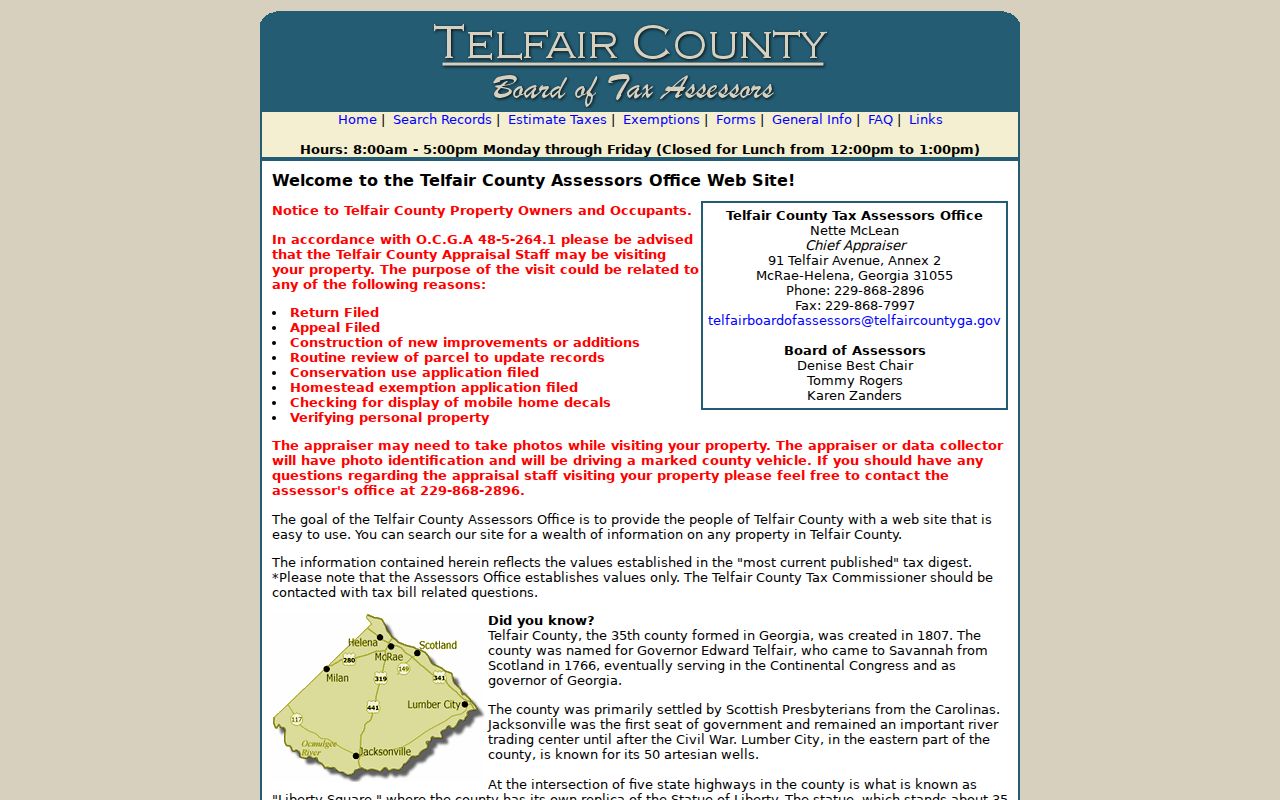
The captured landing page is the reliable gateway even when the separate dynamic parcel application presents an automated-access challenge.
| Search route | Owner name, street or situs address, parcel or account number, and parcel-map navigation where offered |
|---|---|
| Identity clues | Published owner, mailing address, situs address, parcel identifier, and legal-description summary |
| Value clues | Land, improvement, total or assessed values, exemptions, tax district, and tax year where displayed |
| Transfer clues | Sale or transfer history and deed reference where the parcel card supplies them |
Some fields never appear online. Contact the Tax Assessor's Office at 91 Telfair Avenue, Annex 2, McRae-Helena, or call (229) 868-2896. Weekday hours run 8:00 a.m. to 5:00 p.m. The office closes from noon to 1:00 p.m.
Note: A published tax digest can lag a deed recorded after the assessment data was prepared.
GSCCCA Search Fields That Refine a Telfair Match
The statewide land index offers search controls the assessor route lacks. Telfair's Clerk of Superior Court sends land researchers to GSCCCA. Pull a party name from qPublic first. Then narrow by county, instrument type, and date. Enter individuals as last name, first name. Enter entities under their recorded legal names.
| Field | How to use it | Useful caution |
|---|---|---|
| Party Type | Choose grantor or grantee according to the transfer direction | A present owner normally first appears as grantee |
| Instrument Type | Narrow to warranty deed, quitclaim deed, security deed, lien, easement, release, or another listed instrument | A narrow choice can hide related filings |
| County | Select Telfair County; neighboring-county search is separately offered | Milan spans Telfair and Dodge Counties, so confirm jurisdiction |
| Search Name | Enter last name, first name for individuals | Initials, entities, estates, and spelling variants matter |
| Date Range | Limit a likely transaction period | Remove the limit when a transfer date is uncertain |
| Book/Page | Use the separate form when a deed or parcel card gives both references | Book is limited to five characters and page to four on the inspected form |
What a Telfair County Property Record Can Show
No single result proves ownership. Treat each result as a set of clues. A qPublic parcel card organizes tax-digest facts, while a GSCCCA index entry describes one recorded instrument, so read the source and effective date beside every field.
| Published owner | The name carried on the assessment roll, which may trail a newly recorded transfer |
|---|---|
| Situs and mailing addresses | The property's location versus the address used for owner correspondence |
| Parcel identifier | The county key used to reconnect records when street or owner names vary |
| Value fields | Tax-year market and assessed-value context, not an appraisal for a sale |
| Legal-description clue | A summary that can point to land lot, district, subdivision, lot, block, or deed text |
| Transfer reference | A sale date, amount, or book/page link when published; verify it in the recorded deed |
A parcel card cannot settle a boundary. Nor will it reveal every unrecorded claim. That work pairs the legal description with a recorded plat and a licensed survey. For ownership due diligence, read the actual deed and relevant liens rather than an owner-name display.
Telfair's Two Historic Index Bands
The Telfair Kofile QuickLink opens two historic deed-index bands, 1955-1975 and 1975-1995. Pick the year band first. The party, last-name, and first-name controls unlock after that choice. Kofile's own instructions cover grantor and grantee selection, name searching, date range, book, volume, page, and links among related documents. Images then route onward to GSCCCA. That handoff saves a second search.
This older index shines when a chain of title predates the modern statewide range. GSCCCA's live forms cite coverage beginning January 1, 1990, and its general documentation promises statewide county coverage to at least January 1, 1999. Neither pins down Telfair's exact good-from date. Ask the Clerk when a missing year matters.
Note: A failed name search can be a coverage or spelling problem, not proof that no deed exists.
The Courthouse Terminal Fallback
Online access is only one channel. The GSCCAA notes that county clerk offices offer free search terminals during business hours. The internet index service runs around the clock. So a deed recorded in McRae can still be traced from home. It can then be pulled in person or by request.
A written request works best when it names the parties and gives an approximate date. It should also list the instrument type, along with any book/page or parcel number already known. Under Georgia Open Records Act guidance, an agency generally provides access within three business days when practicable. Otherwise it explains the timing, cost, and any exemption that applies. The agency does not have to build a new ownership investigation for you.
When Telfair Addresses Do Not Line Up
A single Telfair property can carry several place names at once. The mailing city, the incorporated boundary, the tax district, and the parcel situs do not always match. McRae and Helena merged in 2015. Older Telfair County deed records and notices may still carry either historic name. Milan straddles the Dodge-Telfair county line. That makes the city name alone a shaky basis for picking an assessor or clerk. Rural tracts are often described by land lot and district instead of a street number.
Anchor the property search to the parcel number and the recorded legal description when the addresses disagree. Try alternate street suffixes and the older municipal names. The GSCCCA Plat Name Search then supplies subdivision, Section/GMD, district, land lot, and date clues. Telfair does not appear in GSCCCA's optional subdivision-property interface. So skip that tool for county subdivision queries.
Choose Address, Owner, or Parcel for a Telfair Search
Each Telfair County search key solves a different identification problem. Start with the most stable identifier, then cross-check the returned parcel or owner of record against a second system.
| Search Key | Best For | Where It Works | Watch Out |
|---|---|---|---|
| Address | A known physical location | qPublic and mapping routes | Historic names, rural descriptions, and McRae-Helena merger-era wording |
| Owner name | Parcels or deeds tied to a person or entity | qPublic and GSCCCA | Trusts, estates, entities, initials, and common names |
| Parcel number | Reconnecting the exact assessed tract | Assessor, tax requests, plats, and city permit requests | It may not be a searchable field in every recorder interface |
Not a title search. A Telfair County property search locates public records but does not guarantee clear title, identify every unrecorded interest, or replace an attorney's title examination.
Protect a Telfair Name With Filing Alerts
The GSCCCA Filing Activity Notification System is known as FANS. It sends voluntary statewide alerts tied to a registered name, address, or document type. Signing up takes only an email address or phone number. Think of it as a monitoring tool. It flags unexpected filing activity. It cannot block a document from being recorded in Telfair County deed records.
When an alert lands, run a fresh property search. Use the exact party name and recording reference. Open the official index entry itself. Contact the Clerk if the filing is unfamiliar. Pairing the alert with the land index keeps an unsolicited notice, or a similar name, from being mistaken for a real change to a particular parcel.